
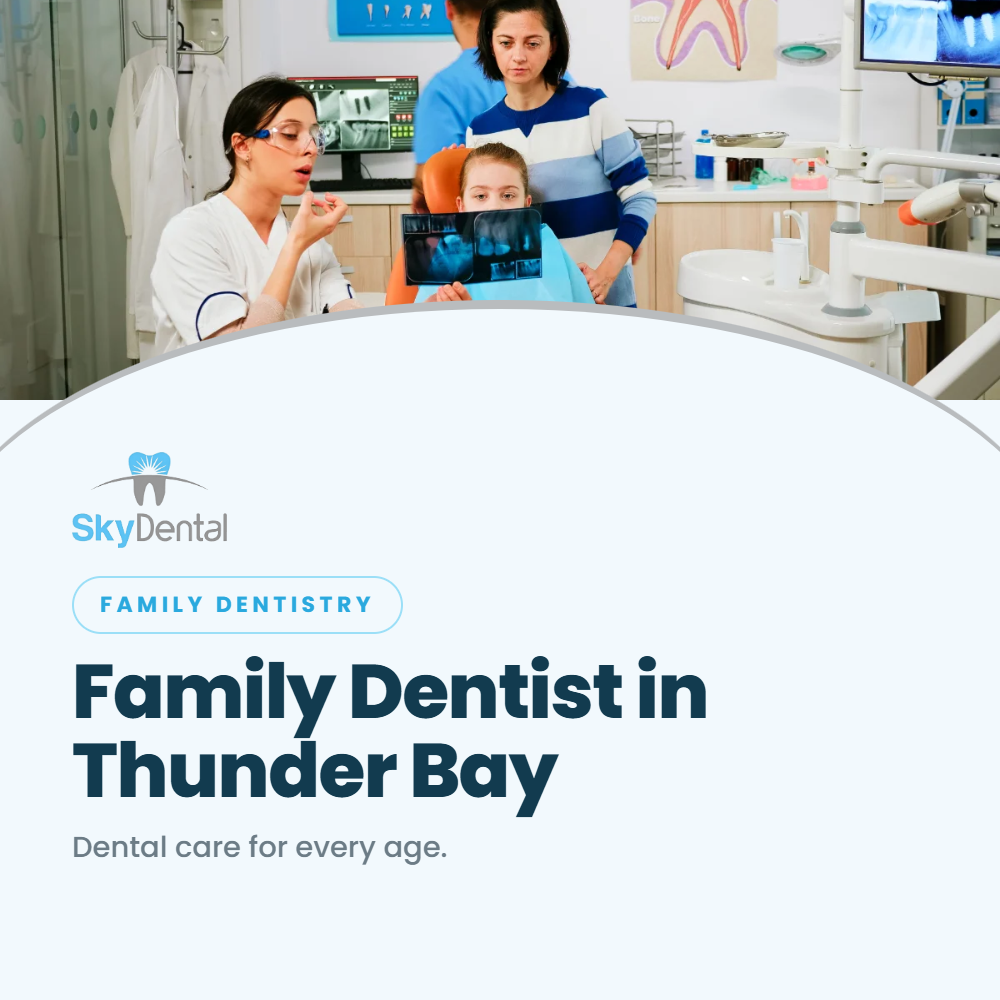
Introduction
Getting your family’s dental care organized —especially when you have children at different stages, adults with different needs, and a schedule that rarely cooperates — takes more coordination than people expect. A family dental practice simplifies at least part of that.
At Sky Dental Centre in Thunder Bay, we see patients from childhood through to adulthood. That continuity matters more than it might seem at first. When your dentist has watched a child’s bite develop over years, has records going back to their baby teeth, and knows which parent passes on what tendencies, the care gets more precise over time — not just more familiar.
This page covers what family dentistry involves, what to expect at different life stages, how preventive care works in practice, and what to look for when choosing a dental home for your household.
What Is a Family Dentist?
A family dentist is a general dentist who sees patients across age groups — from young children to seniors. The term doesn’t refer to a specialty designation; it describes the breadth of a practice’s patient population and the way care is organized.
That’s different from a pediatric dentist, who trains specifically to work with children and whose practice is limited to younger patients. A family dentist can treat your six-year-old and your sixty-year-old at the same clinic, often on the same day. For busy families, the practical convenience is real.
Family dentists are trained to recognize how oral health changes across a lifetime. A child’s teeth require different monitoring than an adult’s. Teens in orthodontic treatment have distinct hygiene challenges. Older adults may deal with recession, dry mouth, or wear patterns that need particular attention. A good family practice accounts for all of this.
General dentist vs. specialist: what to know
A family dentist is a general practitioner. For complex orthodontic cases, oral surgery, or specialized periodontal treatment, they may refer to a registered specialist. At Sky Dental Centre, we handle a wide scope of general and restorative care and will let you know clearly when a referral makes sense.
Benefits of Choosing a Family Dentist
One of the less obvious advantages of a family practice is the longitudinal record. When the same clinic has been seeing your child since their first tooth, the dentist can spot changes that a new provider might miss — shifting bite relationships, a recurring spot that keeps decalcifying, a jaw that’s growing asymmetrically. Context matters in dentistry.
For parents, there’s also a consistency of communication. You get to know the team. Your child gets to know the team. That familiarity reduces the friction that makes dental appointments feel like a production, especially for anxious kids.
None of this means a family dentist is always the right answer for every situation. If your child has significant special needs, a pediatric specialist may be better equipped. If a specific procedure is outside the scope of general dentistry, a referral is the right path. A trustworthy family dentist tells you when that’s the case rather than stretching beyond their competency.
Services Offered at Sky Dental Centre
We provide general and restorative dental care for children, teens, and adults. Our focus is preventive-first — catching problems early, before they become more involved to address. Below is a summary of what we offer.
Preventive Care
Cleanings, exams, X-rays, sealants, and fluoride — the foundation of oral health at every age.
Children's Dentistry
First visits, cavity prevention, bite monitoring, and gentle care tailored to developing teeth.
Emergency Dentistry
Same-day care for dental pain, trauma, broken teeth, and other urgent situations.
A note on fees
We’re transparent about costs before any treatment begins. We follow the Ontario Dental Association fee guide and will review coverage options with you at your appointment. We never perform work without your informed consent and a clear understanding of what’s involved.
How to Help Kids Overcome Dental Anxiety
Dental anxiety in children is genuinely common, and it doesn’t usually come out of nowhere. Most of the time it develops from a bad early experience, from a parent’s own anxiety being picked up on, or simply from the unfamiliarity of the environment — the sounds, the chair, the instruments. Understanding where it comes from makes it easier to address.
Start before a problem exists
The most effective thing parents can do is bring children in early — ideally by their first birthday or within six months of the first tooth. Those early visits aren’t really about cleaning. They’re about normalizing the environment when there’s nothing uncomfortable happening. A child who has visited a dental office a dozen times before they ever need a filling has a very different relationship with it than one who’s only been when something was wrong.
Watch your own language around it
Children absorb tone more reliably than words. Saying “it won’t hurt, I promise” actually creates anticipation of pain rather than reassurance — the brain hears “hurt.” Keeping pre-appointment conversations matter-of-fact and low-key is more helpful than extensive preparation. “We’re going to the dentist to check your teeth” is better than a lengthy explanation of every step.
Tell us in advance
If your child has had a difficult previous experience or has general anxiety, tell us before the appointment. Our team works with anxious children regularly. We can pace the visit differently, use tell-show-do techniques, and adjust our approach based on how your child is responding in the moment. There is no pressure to complete everything in one visit if that’s not what works.
For children with significant dental anxiety or special needs, we can discuss whether additional support options are appropriate. In some cases, referral to a pediatric specialist is the right step — and we’ll say so honestly if that’s what we think.
How Often Should Your Family Visit the Dentist?
The standard recommendation on how often you visit a dentist — typically twice a year — exists for a reason. It aligns with how quickly plaque mineralizes into tartar and how often a trained eye needs to check for early changes. But it’s not a universal prescription. Your family’s ideal recall schedule depends on individual risk factors.
Life Stage | Typical Recommendation | What We’re Watching For |
Infants & Toddlers (0–3) | Every 6 months once teeth appear | Early decay, bite development, hygiene habits |
Children (4–12) | Every 6 months | Cavity risk, sealant eligibility, incoming permanent teeth |
Teens (13–17) | Every 6 months; more frequent during orthodontic treatment | Hygiene around brackets, wisdom teeth, bite alignment |
Adults (18–59) | Every 6–12 months depending on history | Gum health, wear, existing restorations, systemic risk factors |
Older Adults (60+) | Every 6 months, or more frequently | Recession, root decay, dry mouth, prosthetic maintenance |
High-cavity-risk patients, those with gum disease, smokers, and people managing conditions like diabetes may benefit from more frequent visits. We’ll give you a clear recommendation at your appointment rather than applying a one-size-fits-all schedule.
How Family Dentists Treat Cavities Early
The best cavity is one that never fully forms. That sounds obvious, but it reflects something real about how preventive care works: there’s a window, during the early stages of demineralization, where a cavity can actually be reversed without a filling.
When enamel starts to lose minerals — from acids produced by bacteria — it shows up as a white spot lesion before it becomes a true cavity. At this stage, fluoride and improved home care can often remineralize the area. Your dentist can monitor these spots over time and intervene conservatively before drilling becomes necessary.
When a filling is needed
If a cavity progresses into the enamel or dentin, it needs to be restored. We use tooth-coloured composite resin for most restorations — it bonds directly to the tooth, requires less removal of healthy structure than older amalgam restorations, and blends with the natural tooth colour. For children’s baby teeth, the approach depends on the tooth’s lifespan and the extent of decay.
Fissure sealants for kids
The back molars in children are particularly prone to cavities because their chewing surfaces have deep grooves that trap food and are difficult to clean with a toothbrush. Sealants are a thin coating applied to these surfaces to physically block the bacteria-trapping anatomy. The evidence for their effectiveness in reducing molar cavities in children is solid, and the procedure is quick and non-invasive.
Emergency Family Dentist in Thunder Bay: When to Seek Immediate Care
Not every dental problem is an emergency, but some absolutely are. Knowing the difference can save a tooth — particularly for children, where a knocked-out permanent tooth has a chance of being reimplanted if you act fast enough.
Call us immediately
- Knocked-out permanent tooth
- Fractured tooth with nerve exposure
- Significant swelling of face or jaw
- Dental abscess with fever
- Uncontrolled bleeding after extraction
- Trauma to jaw or facial bones
Schedule promptly (same or next day)
- Broken tooth without pain
- Lost crown or filling
- Moderate toothache that worsens
- Chipped tooth with sharp edge
- Soft tissue injury inside mouth
- Child’s tooth knocked loose but still in socket
What to do with a knocked-out tooth
Pick up the tooth by the crown — not the root. If it’s dirty, rinse it gently with milk or saline. If possible, replace it in the socket and bite down gently to hold it in place. If that isn’t feasible, keep it moist in milk or the patient’s own saliva and get to a dentist within 30 minutes. Time is the most critical factor.
Sky Dental Centre offers same-day emergency appointments. If you’re experiencing a dental emergency in Thunder Bay, call our office directly and we will make every effort to see you that day.
How to Choose the Right Family Dentist in Thunder Bay
There are several dental practices in Thunder Bay. Choosing one for your family is worth some thought, particularly if you have young children or family members with specific needs. Here are the factors that tend to matter most over time.
Scope of services
Check whether the practice genuinely treats all ages or primarily adults. Some clinics use the word “family” loosely. Ask specifically whether they see children under five and whether they have experience with pediatric care. A practice that regularly treats toddlers will have a different physical setup and a different communication style than one that occasionally sees children.
Communication style
You should leave every appointment with a clear understanding of what was found, what was done, and what the plan is going forward. A dentist who can explain a treatment recommendation in plain language — including why it’s recommended, what happens if you wait, and what the alternatives are — is a dentist you can make genuinely informed decisions with.
Consistency of care team
High staff turnover at a dental clinic means you’re reintroducing yourself and your family repeatedly. Practices where you see the same hygienist and dentist over multiple years tend to deliver more consistent care, particularly for patients who have anxieties or need extra accommodation.
Availability for emergencies
Ask directly: what happens if my child knocks out a tooth on a Saturday afternoon? A practice that offers same-day emergency care is fundamentally different from one where you’d be told to go to the emergency room. That distinction becomes very relevant when something actually happens.
Why Families Choose Sky Dental Centre
We’re not in the business of making claims we can’t back up, so we’ll keep this straightforward. Here’s what we consistently focus on, and what patients tell us they value about our practice.
Genuine preventive focus
We’re not looking for things to do. We’re looking for things that actually need attention — and we’ll tell you when that’s nothing.
Clear communication
We explain what we find and why we’re recommending what we’re recommending. You’ll never leave without understanding your options.
Welcoming for children
We see children regularly and know how to work with kids at different developmental stages — including those who are nervous or have had difficult past experiences.
Same-day emergency care
Dental emergencies don’t schedule themselves. We do our best to accommodate urgent situations the same day you call.
Accepting new patients
We’re currently welcoming new patients and families of all sizes. You don’t need a referral — you can call us directly or request online.
Full scope of general dentistry
From preventive cleanings to Invisalign to implants, most of your family’s dental needs can be addressed in one place.
Frequently Asked Questions
At what age should my child first see a dentist?
By age one, or within six months of the first tooth appearing. That first visit is mostly about familiarization — the dentist checks what’s there, talks through hygiene basics with you, and begins establishing a record. It doesn’t take long and rarely involves anything uncomfortable for the child.
How often should my family visit the dentist?
Twice a year is the standard starting point, but your dentist may adjust this based on individual risk factors. Higher cavity risk, gum disease, or active orthodontic treatment often warrants more frequent visits. Some adults with consistently healthy mouths and low risk may do fine annually. We’ll give you a specific recommendation after your first appointment.
Can a family dentist treat teens with braces or Invisalign?
Yes — at Sky Dental Centre we offer orthodontic assessment and Invisalign for teens and adults. More complex alignment cases may be referred to an orthodontist if that’s the appropriate level of care. We’ll assess your teen’s situation and give you a clear recommendation.
What counts as a dental emergency for a child?
A knocked-out or fractured permanent tooth, significant facial swelling, dental abscess, or uncontrolled bleeding all warrant same-day care. Call us directly and describe what’s happened — we’ll tell you immediately whether it’s something to address today or whether you have a little more time.
Does Sky Dental Centre accept new patients?
Yes, we’re currently accepting new patients of all ages. No referral is needed. You can call us directly or use our online booking form to schedule a first appointment for one or more family members.
Ready to Book for a Family Dentist in Thunder Bay?
Sky Dental Centre is accepting new patients of all ages in Thunder Bay. Call us to schedule, or use our online form — whichever works better for you.