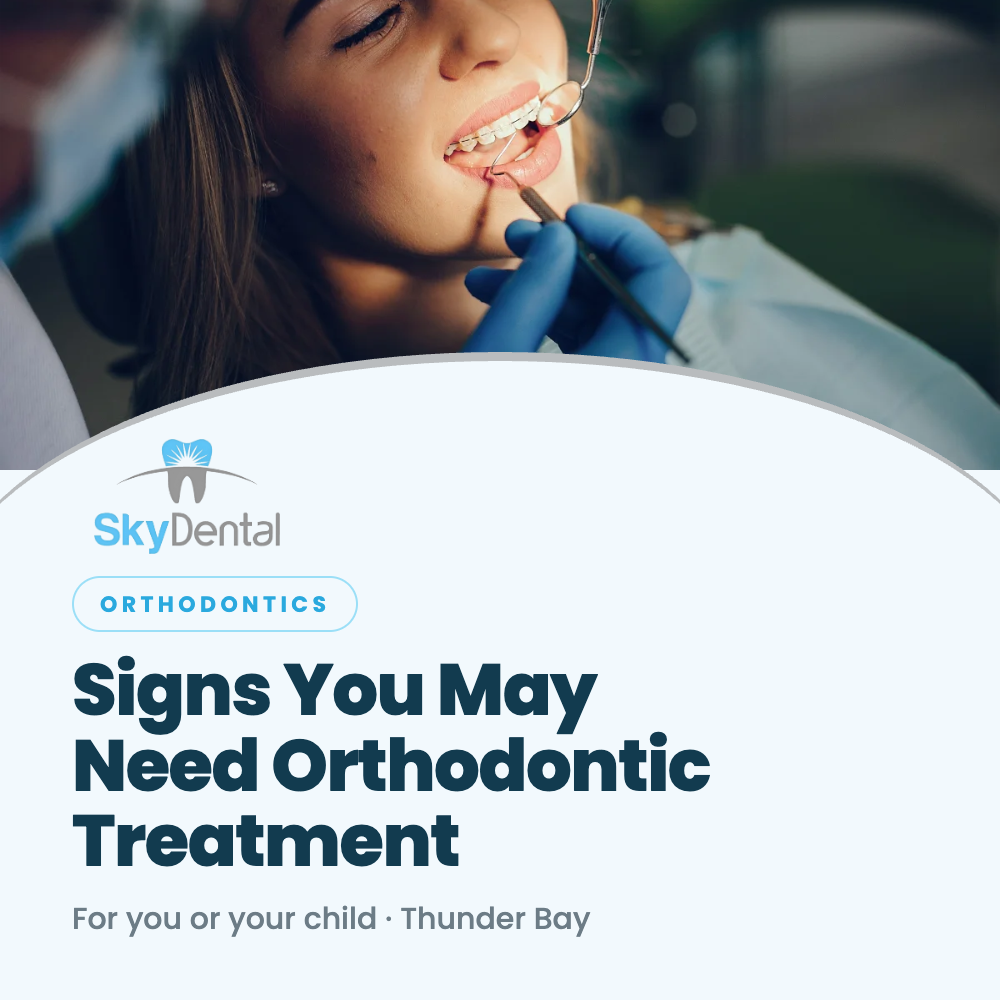
Common orthodontic treatment signs include crowded or overlapping teeth, gaps, upper teeth that stick out, a bite where the teeth do not meet properly, a jaw that shifts when closing, and baby teeth lost much earlier or later than expected. For children, the American Association of Orthodontists recommends a first orthodontic check no later than age 7. Not every sign means treatment is needed right away. This guide explains what to watch for in children and adults, how to answer “does my child need braces?”, and what an assessment involves for Thunder Bay families.
What Are the Most Common Orthodontic Treatment Signs?
Sign | What it may mean |
Crowded or overlapping teeth | Not enough room in the jaw |
Gaps between teeth | Tooth size differences, missing teeth, or habits |
Upper front teeth that stick out | Overjet; higher risk of injury to those teeth |
Lower teeth in front of upper teeth | Underbite |
Upper teeth biting inside lower teeth | Crossbite |
Front teeth that do not meet | Open bite |
Jaw shifting to one side when closing | Bite interference |
Uneven wear on teeth | Bite forces not spread evenly |
These signs are reasons for an assessment, not a diagnosis. Some problems are mild and can be monitored.
Does My Child Need Braces? Signs to Watch For
Parents often ask “does my child need braces?” Signs that are worth mentioning at your child’s next check-up include:
- Baby teeth lost much earlier or later than other children the same age
- Crowding as adult teeth come in
- Front teeth that stick out noticeably
- Teeth that do not meet when biting
- Thumb sucking or other habits that continue as adult teeth come in
- Difficulty chewing or biting
- Mouth breathing or snoring
- A jaw that shifts or makes sounds
The American Association of Orthodontists recommends that children first see an orthodontist no later than age 7. Many children seen at that age do not need treatment right away. The check helps spot problems early, and some may be easier to manage while the jaw is still growing.
What Is Early Orthodontic Treatment?
Some children benefit from treatment while their jaws are growing, sometimes called early or phase one treatment. It may be considered for crossbites, severe crowding that is likely to worsen, front teeth at risk of injury, or habits affecting the bite. Early treatment may use expanders or partial braces and is often followed by a second phase once more adult teeth come in.
Many children do not need early treatment. Your dentist will explain whether to treat now, wait, or simply monitor at future check-ups.
Orthodontic Treatment Signs in Teens
The teen years are a common time for comprehensive treatment, because most adult teeth have come in and the jaw is still developing. Signs in teens include crowding, crooked teeth, gaps, and bite problems that have become clearer as adult teeth settle. Teens with braces or aligners need extra care with cleaning and with sports drinks, and a mouthguard for contact sports.
Orthodontic Treatment Signs in Adults
Adults may notice:
- Teeth shifting or becoming more crowded over time
- Food getting stuck in the same spots
- Areas that are hard to clean
- Uneven tooth wear
- Jaw soreness or clicking when chewing
- Teeth that moved after braces as a teen, often because retainers were stopped
Gum changes and tooth loss can let teeth shift even after previous treatment. Our guide to adult orthodontics in Thunder Bay explains what is different for adults.
Bite Problems That Are Easy to Miss
An overbite, underbite, or crossbite is not always obvious in the mirror. Clues include jaw soreness, clicking when chewing, uneven tooth wear, cheek biting, or difficulty biting into foods like sandwiches. A lisp can sometimes relate to tooth position, though it has several possible causes. Mention any of these at a check-up.
Mouth Breathing, Snoring, and Bite Development
Regular mouth breathing or snoring in children can sometimes relate to enlarged tonsils or adenoids, nasal blockage, or jaw development. These can have medical causes, so talk to your child’s doctor as well as the dentist. The dentist can look at how teeth and jaws are developing, while the doctor can assess breathing.
What Happens at an Orthodontic Consultation?
- Conversation: your concerns, your child’s habits, and dental history.
- Examination: teeth, bite, jaw movement, and gums.
- Records: photos, X-rays, and sometimes a scan or impressions.
- Recommendation: treat now, wait, monitor, or refer.
- Plan and estimate: if treatment is recommended, options, timing, and costs are explained.
Not every consultation leads to treatment. Sometimes the recommendation is to watch how teeth develop and check again at future visits.
What Treatment Options Might Be Recommended?
Option | Often used for |
Monitoring | Mild issues or children who are still developing |
Space maintainers | Holding space after early loss of a baby tooth |
Expanders | Narrow upper jaws in growing children |
Braces | A wide range of alignment and bite problems |
Clear aligners | Many mild to moderate cases, assessed individually |
Referral to a specialist | Complex bite or jaw problems |
Learn more about our orthodontic services in Thunder Bay and Invisalign.
Why Should You Not Wait Too Long?
Some problems are easier to address while the jaw is still growing, and others, such as front teeth that stick out, carry a higher risk of injury. Waiting can also allow crowding to worsen or make cleaning harder. That said, many problems can safely be monitored, and an assessment tells you which applies.
How Can You Help Your Child’s Teeth Develop Well?
- Book regular check-ups so development can be monitored.
- Help children break long-term thumb or pacifier habits, with your dentist’s guidance.
- Encourage good brushing and limit sugary snacks and drinks.
- Use a mouthguard for contact sports.
- Mention any snoring, mouth breathing, or jaw problems to your dentist and doctor.
General Dentist or Orthodontist?
At Sky Dental Centre, our general dentist can assess orthodontic signs and treat suitable cases, and refers complex bite or jaw problems to a specialist orthodontist. For general information, see the Canadian Association of Orthodontists.
Orthodontic Signs by Age at a Glance
Age | What to watch for | Typical next step |
Under 6 | Thumb or pacifier habits, crossbites, early loss of baby teeth | Mention at check-ups |
6 to 9 | Crowding as front adult teeth come in, protruding teeth, crossbites | Orthodontic check by about age 7 |
10 to 14 | Crowding, bite problems, baby teeth not falling out | Assessment for comprehensive treatment |
Teens | Crooked teeth, gaps, bite issues | Braces or aligners if recommended |
Adults | Shifting, new crowding, uneven wear, relapse | Adult assessment |
How Do Habits Affect Teeth?
Thumb sucking, pacifier use, and tongue thrusting can push teeth out of position or affect how the jaws develop if they continue as adult teeth come in. Many children stop on their own. If a habit continues, your dentist can suggest gentle ways to help and check whether it is affecting the bite. Praise and simple reminders often work better than pressure.
Can Crooked Teeth Affect Oral Health?
Crowded or overlapping teeth can be harder to clean, so plaque may build up in some areas, raising the risk of decay and gum problems. Bite problems can cause uneven wear or chipping. Protruding front teeth are more likely to be injured in falls or sports. These are some of the reasons an assessment may be recommended even when appearance is not the main concern.
What Should You Bring to an Assessment?
Bring a list of your child’s habits and any concerns, recent dental records or X-rays if you have them, insurance details, and your questions. For adults, mention previous orthodontic treatment, gum problems, and any planned dental work.
How Much Does Orthodontic Treatment Cost?
Cost depends on the problem, the type of treatment, the length of treatment, and whether retainers and refinements are included. Many dental plans have orthodontic coverage, sometimes with age limits and lifetime maximums. Ask for a written estimate and check your coverage before starting.
Questions Parents Often Ask at the First Orthodontic Visit
- Does my child need treatment now, or should we wait?
- What happens if we wait?
- Will my child need more than one phase of treatment?
- How will treatment fit around school and activities?
- How can we help at home?
What Happens If You Decide to Wait?
If your dentist says a problem can be monitored, you will usually be asked to come back for regular checks so changes can be spotted. Keep up brushing, cleaning between teeth, and check-ups during this time. If you notice new crowding, jaw pain, or difficulty chewing, mention it sooner. Waiting is often a reasonable choice, especially for mild issues or children who are still developing.
Preparing Your Child for an Orthodontic Visit
Explain that the dentist will look at their teeth and may take pictures, using simple and positive words. Let them know the visit does not hurt, and that they can ask questions. Bringing a comfort item and booking a time when your child is rested can help the visit go smoothly.
Orthodontics and Sports
Children and teens in contact sports should wear a mouthguard, especially if front teeth stick out or if they wear braces. Ask your dentist about a mouthguard that fits around braces. Protecting teeth during sports helps prevent injuries that can complicate orthodontic treatment.
Common Myths About Orthodontic Signs
- “Crooked baby teeth mean crooked adult teeth.” Not always; spacing in baby teeth is often normal and helpful.
- “Kids should wait until all adult teeth come in before any check.” An earlier check can spot issues worth monitoring.
- “Braces are only cosmetic.” They can also improve the bite and make cleaning easier.
- “Adults are too old for braces.” Age alone does not rule out treatment.
How Orthodontic Problems Develop
Many orthodontic problems are inherited, such as jaw size or tooth size differences that lead to crowding or spacing. Others are influenced by habits, early loss of baby teeth, injuries, or breathing patterns. Understanding the cause helps your dentist decide whether a problem is likely to improve on its own, stay the same, or get worse, which guides whether to treat, wait, or monitor.
Orthodontic Treatment Signs Summary
If you notice crowding, gaps, protruding teeth, bite problems, early or late loss of baby teeth, or ongoing habits, mention them at your next check-up. Early assessment gives you information, not an obligation to start treatment. For many families, the answer is simply to keep watching and check again at future visits. Bringing your questions and any concerns about habits, breathing, or jaw comfort to that visit helps the dental team give you a clear answer.
Your Next Step
If any of these signs sound familiar, note when you first noticed them and bring that information to your next visit. Even a short list helps the dentist understand how things are changing.
Key Takeaways
- Crowding, gaps, protruding teeth, and bite problems are common orthodontic treatment signs.
- A first orthodontic check is recommended no later than age 7.
- Many children are monitored rather than treated right away.
- Adults can notice new crowding or shifting over time.
- An assessment is the only way to know whether treatment is needed.
Frequently Asked Questions
How do I know if my child needs braces?
Watch for crowding, gaps, protruding front teeth, teeth that do not meet, early or late loss of baby teeth, and long-term thumb sucking. A dental assessment can confirm whether treatment is needed.
At what age should my child have an orthodontic check?
The American Association of Orthodontists recommends a first check no later than age 7. Many children do not need treatment at that age.
Do all crowded teeth need braces?
No. Mild crowding may only need monitoring. An exam tells you whether treatment would help.
Is it too late to get braces as an adult?
No. Many adults get braces or clear aligners. Gum and bone health matter more than age.
How do I know if I need a specialist orthodontist?
Your dentist will assess your case and refer you if it involves complex bite or jaw problems.
Book an Orthodontic Assessment in Thunder Bay
Noticing any of these signs in yourself or your child? Book an orthodontic assessment at Sky Dental Centre in Thunder Bay. We will look at your teeth and bite and explain whether to treat now, monitor, or refer.
*This article is general information, not dental advice for your situation.*