Veneers can be a genuinely good solution for the right cosmetic concern, and a poor fit for the wrong one. Before booking, it helps to have an honest sense of whether your specific situation is a good match. At Sky Dental Centre, Dr. Ameen (BDS, DDS), a general dentist, starts every veneer conversation with candidacy, not a sales pitch, so you know what to expect before committing to anything. We see patients from across Thunder Bay for this conversation, from Current River to Westfort, and the same standard applies no matter where you’re coming from: the concern has to genuinely fit the treatment.
What Kinds of Concerns Are Veneers Actually Good For?
Veneers work well for a specific set of cosmetic concerns. Intrinsic discolouration, staining from within the tooth structure caused by tetracycline antibiotic use, fluorosis, or developmental factors, does not respond to whitening, and a veneer covering the visible surface addresses this directly. Small chips on the edges or corners of front teeth are one of the more straightforward applications, restoring shape without extensive tooth reduction.
Small gaps between front teeth can often be reduced or closed by widening the adjacent teeth with a veneer, an alternative to orthodontic treatment for genuinely minor spacing. Teeth that are naturally undersized, irregularly shaped, or peg-shaped can be built up to achieve more consistent proportions across your smile. Veneers can also restore some length and shape to teeth that are mildly worn from grinding or acid erosion, though the underlying cause of the wear needs to be addressed separately, otherwise the new veneer wears down the same way the natural tooth did.
What Makes Someone a Strong Candidate for Veneers?
A few honest questions can help you assess your own fit before your consultation, though a clinical exam is the only way to confirm any of this. Is your primary concern about colour, shape, or minor spacing, rather than the position or alignment of your teeth? Veneers change appearance, not position, a tooth that is rotated or significantly out of alignment will still read as rotated underneath a veneer.
Do you have healthy gums and no active decay? Veneers, whether composite or porcelain, are placed on a stable foundation, active gum disease or untreated cavities need to be resolved first. Is your concern limited to a specific tooth or a few teeth, rather than a comprehensive smile change involving many teeth and a significant bite adjustment? Smaller, targeted cases are often the clearest fit for composite veneers specifically, given the same-day, minimal-preparation approach.
Are you realistic about maintenance? Composite veneers pick up staining over time and may need periodic polishing or resurfacing, this is a genuine trade-off for the convenience and lower cost, not a hidden downside discovered later. For general background on how veneers work and how to care for them, the American Dental Association’s MouthHealthy resource is a useful outside reference alongside what’s covered here.
When Are Veneers Not the Right Choice?
Significant misalignment or crowding is not something a veneer can meaningfully correct, since it only changes the visible surface, not the underlying tooth position. If straightening is your actual goal, orthodontic treatment or Invisalign is the more appropriate starting point, and veneers may not even be necessary once alignment is addressed.
Very deep or extensive discoloration that would require an unusually thick layer of composite or porcelain to mask adequately may be better served by a different restorative approach, since an overly thick veneer can look bulky or unnatural. Active decay or gum disease must be treated before any cosmetic work proceeds, veneers are not a way to cover up an underlying problem that needs its own attention first.
Where a tooth is structurally compromised, significantly decayed, cracked, or too damaged for a veneer to adequately protect, a full crown is the more appropriate option, since it encases the entire tooth rather than just the front surface. Patients hoping for a completely uniform, artificially perfect smile across every tooth should also have a candid conversation with their dentist about what a natural-looking result actually involves, since the goal at Sky Dental Centre is a smile that complements your face, not one that looks obviously done.
What Should You Expect at a Veneer Consultation?
The consultation starts with an honest conversation about what is actually bothering you about your smile, followed by a clinical exam of your teeth, gums, and bite to confirm there are no underlying issues that need addressing first. Photographs are often taken to help plan shade and shape, and to give you a clear before reference to compare against later.
Your dentist will tell you directly whether your case is a good fit for composite veneers, porcelain veneers, or an entirely different approach, based on what the exam actually shows, not on what would be the most convenient answer. If composite veneers are appropriate and you would like to proceed the same day, this can often be arranged at the same appointment, since composite veneers do not require a laboratory fabrication period the way porcelain does.
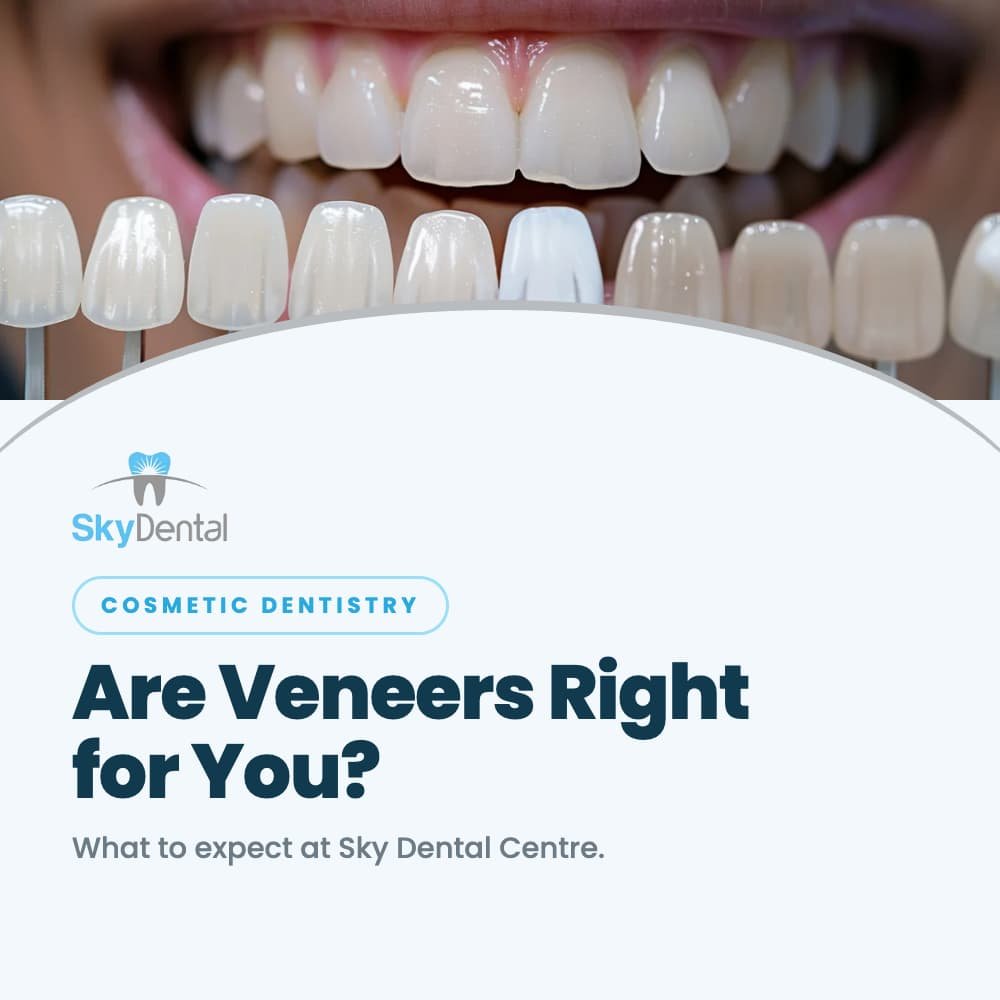
Shade selection happens under different lighting conditions to get an accurate match, and if multiple teeth are being treated, the plan accounts for consistent proportion and colour across all of them, not just each tooth in isolation. All of this takes place within the same same-day veneers appointment structure described on our service page, and the Canadian Dental Association also covers veneers as part of its general procedures overview.
How Do You Decide Between Composite and Porcelain for Your Case?
The decision comes down to your specific goals, timeline, and budget, more than a fixed rule about which material is universally better. If you want a same-day result with minimal tooth reduction and lower upfront cost, and you are comfortable with periodic maintenance and somewhat less colour stability over time, composite veneers fit that profile well.
If colour stability, surface hardness, and long-term durability matter more to you than same-day convenience, and you are comfortable with a one to two week laboratory fabrication period and typically more tooth preparation, porcelain may be the better fit. Cases involving more extensive discolouration, larger cosmetic corrections, or where long-term durability is the priority often lean toward porcelain, while smaller, targeted corrections and patients wanting to avoid a longer timeline often lean toward composite. Your dentist will walk through this trade-off specifically for your case rather than defaulting to one material for everyone, whether you’re coming in from Vickers Heights or McIntyre.
Frequently Asked Questions
How do I know if I am a good candidate for veneers?
The clearest sign is that your main concern is about colour, shape, or minor spacing rather than the position or alignment of your teeth, since veneers change appearance but not underlying tooth position. Healthy gums and no active decay are also required before cosmetic work can proceed, so any existing dental issues need to be addressed first. A clinical exam is the only way to confirm candidacy for your specific case, since factors like bite relationship and the exact nature of your discolouration or damage vary considerably between patients and are not something you can fully assess on your own before a consultation. Coming to your consultation with a clear sense of what specifically bothers you about your smile, rather than a vague sense that something should change, also helps the conversation focus on realistic options.
Can veneers fix crooked teeth?
Not meaningfully, veneers address the appearance of the front surface of a tooth, not its underlying position, so a tooth that is rotated or significantly misaligned will still read as misaligned beneath a veneer. If straightening your teeth is the actual goal, orthodontic treatment or Invisalign is the appropriate starting point, and in many cases achieves enough of a cosmetic improvement on its own that veneers turn out not to be necessary afterward. Attempting to mask real alignment problems with veneers alone is one of the more common reasons a cosmetic result ends up disappointing a patient, which is why this distinction matters at the consultation stage.
Do veneers require a lot of tooth preparation?
It depends on the material and the specific case. Composite veneers generally require minimal to no tooth reduction in most cases, since the material bonds directly to the enamel surface without needing significant shaping first. Porcelain veneers typically require more tooth preparation to create adequate space for the material and achieve a natural-looking result. This is one of several trade-offs worth weighing at your consultation, since more conservative tooth preparation with composite comes alongside somewhat less durability and colour stability compared to porcelain over the long term. Asking directly which approach applies to your specific teeth, rather than assuming based on general descriptions online, gives you the clearest picture before deciding.
What if I am not sure whether I want composite or porcelain?
That is a completely reasonable place to start, and it is exactly what the consultation is for. Your dentist will walk through the trade-offs specific to your case, timeline, budget, the extent of your cosmetic concern, and how much long-term durability matters to you, rather than expecting you to arrive with a firm answer already decided. Bringing photos of results you like, or being clear about what bothers you most about your current smile, helps the conversation focus on what actually matters to you rather than a generic overview of both materials. There is no obligation to decide before your appointment, arriving with an open mind and a clear sense of your priorities is often more useful than researching every detail in advance.
Will my veneers look natural or obviously fake?
Well-planned veneers, whether composite or porcelain, are designed to complement your face and blend with your remaining natural teeth, not to look uniformly perfect in a way that reads as obviously cosmetic. Shade matching under different lighting conditions and attention to proportion relative to your other teeth are both part of getting a natural result. If you are hoping for an extremely uniform, very bright result across every visible tooth, it is worth having a candid conversation with your dentist about what that would actually look like, since the most natural results tend to work with your existing smile rather than override it completely.
Ready to find out honestly whether veneers are the right fit for you? Book a cosmetic consultation with Sky Dental Centre in Thunder Bay.