
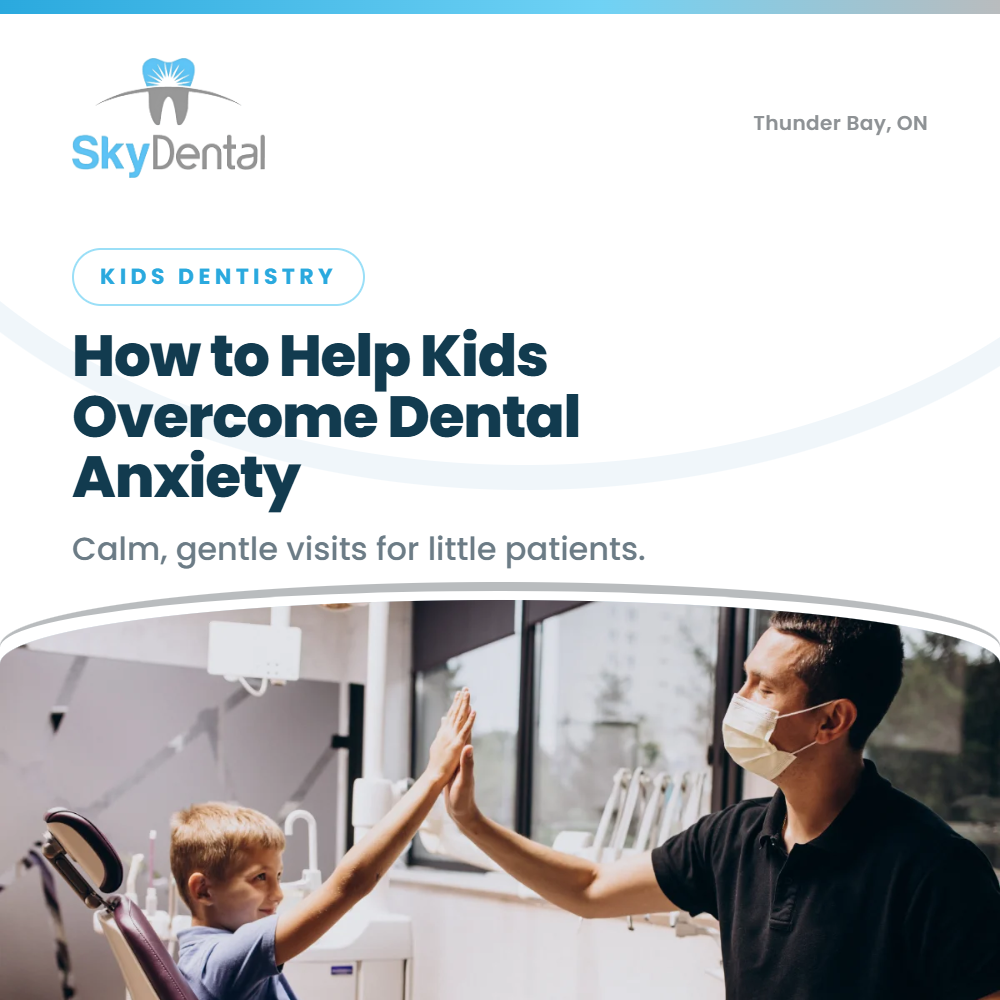
Introduction
Dental fear is one of the most common childhood anxieties — and one of the most manageable. With the right preparation, the right language, and the right dental team, most children eventually settle into visits that feel routine rather than stressful.
Somewhere between 10 and 30 percent of children experience dental anxiety significant enough to affect their care. That’s not a small number — and it doesn’t mean those children are unusually fearful. Dental offices are genuinely unusual environments. The sounds, the smells, the unfamiliar equipment, the fact that someone is working inside their mouth — any one of those things could reasonably make a child hesitant.
What matters is how that hesitation gets handled. A child who has one stressful dental experience, and whose anxiety gets reinforced rather than addressed, can carry that discomfort into adulthood. A child whose early experiences are calm and positive builds a very different relationship with dental care — one that serves them for life.
This guide covers the reasons dental anxiety develops in children, how to recognize it, and what parents and dental teams can do to help.
Why Children Develop Dental Anxiety
Dental anxiety rarely appears out of nowhere. It usually has a traceable source — and identifying it makes it easier to address.
Fear of the unknown
Children who haven’t been to a dental office before have no frame of reference for what will happen. The chair moves. Instruments are placed in their mouth without them fully understanding why. Lights shine in their eyes. None of it is painful in a routine visit, but it’s unfamiliar — and unfamiliar is often enough to trigger discomfort in a young child. This is one of the strongest arguments for bringing children in early, before anything needs to be treated.
Previous negative experiences
A child who had a painful or frightening dental experience — whether at a previous practice, during an emergency, or simply because they were very young and unprepared — may approach every subsequent visit with that memory active. This kind of conditioned anxiety is real and doesn’t resolve on its own. It needs to be actively managed over several visits, with a team that understands what they’re working with.
Sensitivity to sounds and smells
The sensory environment of a dental office is distinctive. The sound of a suction device, the smell of dental materials, the buzz of equipment — these can feel overwhelming for children who are more sensory-sensitive. Some children with sensory processing differences find dental environments particularly challenging for this reason.
Anxiety passed on from parents or siblings
Children read the adults around them. A parent who visibly dreads their own dental appointments, or who uses casual phrases like “the dentist is going to hurt you if you don’t brush,” transmits that anxiety directly. Siblings who describe frightening experiences have the same effect. Children don’t have the context to calibrate those accounts — they take them at face value.
Signs Your Child May Be Nervous About Dental Visits
Not all dental anxiety is visible in the chair. Some children show it long before the appointment. Recognizing the signs early gives you time to address them rather than arriving at the clinic already in a difficult situation.
- Trouble sleeping the night before an appointment
- Crying or firmly refusing to attend when reminded
- Complaints of stomach aches or nausea on appointment day
- Shutting down or going quiet when the dentist is mentioned
- Increased irritability in the days leading up to a visit
- Requests to cancel or reschedule — repeatedly
If your child consistently shows these signs, let us know before the appointment. That context shapes how we approach the visit from the moment they walk in.
Tips to Help Kids Feel Comfortable at the Dentist in Thunder Bay
Most of the work happens at home, before you ever arrive at the clinic. How you talk about dental visits, when you start them, and what you do in the days before all make a meaningful difference.
Start dental visits early
The first visit should happen by age one or within six months of the first tooth appearing. Early visits are short, low-key, and focused on familiarity rather than treatment. A child who has been to the dental office a dozen times before they ever need a filling has a very different baseline than one who only goes when something is wrong.
Use positive, neutral language
Words carry weight. Saying “it won’t hurt” plants the idea of pain before anything has happened. Keeping language matter-of-fact — “we’re going to check your teeth” — is more effective than either false reassurance or detailed preparation. Enthusiasm helps too, but don’t overdo it — children can detect performance.
Avoid sharing negative experiences
If you’ve had a difficult dental experience yourself, that’s not something your child needs to hear before their appointment. Your own anxiety is valid, but sharing it in detail has a direct effect on how your child walks into the clinic.
Read books or watch videos about dental visits
There are good age-appropriate books that depict dental visits as normal, manageable experiences. Reading one together in the week before an appointment normalizes the environment before your child has walked through the door.
Schedule morning appointments
Children are typically less fatigued, hungrier for distraction, and more cooperative earlier in the day. Afternoon appointments — especially post-nap or after school — often catch children at their most depleted, which makes anxiety harder to manage.
Bring a comfort item
A familiar toy, stuffed animal, or blanket gives an anxious child something to hold and focus on. It’s a small thing, but it works. We’re happy to accommodate comfort items — just let our team know when you arrive.
How Family Dentists Help Reduce Dental Anxiety in Thunder Bay
A family dental team that regularly sees children doesn’t just apply adult techniques to smaller patients. The communication, pacing, and environment are genuinely different — and they should be.
Gentle communication techniques
Tell-show-do is a foundational approach: describe what you’re going to do, demonstrate it on a model or the back of a finger, then do it. Nothing happens without the child knowing it’s coming. This reduces the startle response that makes the first touch feel like a threat.
Child-friendly environment
The physical space matters. Lower counters, age-appropriate visuals, chairs that don’t feel imposing — these details signal to a child that this place was designed with them in mind. It’s not cosmetic; it genuinely reduces the novelty-driven anxiety that an adult-focused clinical environment can trigger.
Positive reinforcement
Acknowledging what a child does well — even small things, like sitting in the chair without fuss — builds the association between dental visits and positive feedback. Over time, that association becomes the dominant one. We don’t manufacture praise, but genuine acknowledgment is something we use deliberately.
Gradual introduction to treatments
An anxious child doesn’t need a full cleaning on their first visit. Sometimes the right approach is to sit in the chair, get a quick count of the teeth, and go home with a sticker. Building trust in increments is more effective than forcing a complete appointment and creating a difficult memory.
At Sky Dental Centre, we ask parents to let us know in advance if their child is anxious or has had a difficult previous experience. That context changes how we approach the appointment from the start — not just what we do in the chair.
What Parents Should Avoid Before a Dental Appointment in Thunder Bay
Some well-intentioned parenting habits backfire in the dental context. These are the most common ones worth reconsidering.
1. Using words like “pain,” “needle,” or “shot.” Even framed as reassurance — “it won’t hurt” — these words prime the brain for discomfort. Describe the visit without pain language.
2. Using the dentist as a threat or punishment. “If you don’t brush, the dentist will have to drill your teeth” is a phrase that creates lasting fear. It frames dental care as a consequence of failure rather than a routine part of health.
3. Overexplaining procedures. Children don’t need a step-by-step account of what’s going to happen. More detail often creates more anxiety, not less. Keep the pre-appointment conversation brief and upbeat..
4. Projecting your own anxiety. Parents who are nervous themselves sometimes telegraph that through tone, body language, or over-preparation. Children pick up on this even when nothing is said explicitly.
5. Promising that “nothing will happen.” If something does need to be addressed, the broken promise makes future visits harder. Keep your language honest without being alarming.
Benefits of Early Positive Dental Experiences
The work parents and dental teams put in during the early years pays dividends for a long time. Children who develop a comfortable relationship with dental care tend to carry that into adulthood in ways that are genuinely measurable.
Lifelong habits
Children who feel positive about dental visits are more likely to keep up with regular checkups as teenagers and adults — the age groups where avoidance becomes most costly.
Reduced adult anxiety
Dental phobia in adults is largely a product of early negative experiences. Prevention starts in childhood. Positive early visits reduce the likelihood of avoidance-driven dental problems later.
Earlier detection
A child who attends regularly gives their dentist the opportunity to catch developing problems — misaligned teeth, early cavities, gum issues — before they become more involved to treat.
Easier preventive care
Cleaning, fluoride application, and sealant placement are all far simpler when a child is comfortable and cooperative. The same procedures take significantly longer and carry more stress for anxious patients.
When Dental Anxiety May Need Extra Support
Most children’s dental anxiety responds well to patient, consistent care from a family dental team. But that isn’t true for every child, and it’s worth knowing when additional support becomes the right conversation to have.
Severe fear or panic responses
If a child consistently panics — not just cries, but becomes physically unmanageable or distressed to the point of exhaustion — routine management techniques may not be sufficient. This level of anxiety can indicate a need for a formal behavioral approach or a referral to a pediatric dentist with additional training in managing phobic responses.
Children with special needs or sensory sensitivities
Children with autism spectrum disorder, sensory processing differences, ADHD, or certain developmental conditions may require accommodations beyond what a standard family practice can provide during a typical appointment slot. We’re happy to discuss what accommodations are possible for your child — and we’ll be honest if a referral to a specialist is the better path.
Sedation options
In some cases, nitrous oxide (laughing gas) or other sedation approaches may be clinically appropriate to allow necessary treatment to be completed safely and without distress. This is a discussion to have directly with your dentist, who can assess your child’s specific situation and whether sedation is indicated. It is not a routine first step — but it is a legitimate option when the clinical picture warrants it.
Our approach: We do not push treatment forward if a child is genuinely distressed. Stopping, rescheduling, or adjusting the plan is always an option. Our goal is a child who leaves the appointment with a better association with dental care than when they arrived — even if that means less got done today.
Why Families in Thunder Bay Choose Sky Dental Centre
At Sky Dental we see children regularly and have built our approach around making those visits work — for the child, and for the parent who brought them in.
- We ask about anxiety before the appointment begins. Our intake process includes questions about past experiences and any known fears, so we’re not discovering a problem for the first time in the chair.
- We work at the child’s pace. We don’t push appointments forward on a fixed timeline when a child needs more time to settle. A partial visit done well is more valuable than a complete one done poorly.
- Our team works with children consistently. Familiarity with the same hygienist and dentist reduces the novelty factor that drives anxiety. We aim for continuity across visits.
- We give parents clear guidance for home preparation. After your first appointment, you’ll leave knowing what to do before the next one — not guessing.
We accept new patients of all ages, including children who are anxious or who have had difficult experiences elsewhere.
Frequently Asked Questions
Is dental anxiety common in children?
Yes — it’s one of the most commonly reported childhood fears. Estimates range from 10 to 30 percent of children experiencing meaningful dental anxiety. It’s not unusual, and it’s not a sign that something is wrong with your child. With consistent, patient care it almost always improves over time.
At what age should kids start seeing a dentist?
By age one, or within six months of the first tooth. Starting early establishes a routine before any treatment is needed. These first visits are typically brief, low-key, and focused on helping your child get comfortable — not on completing a clinical workup.
How can I prepare my child for a dental visit?
Keep your language neutral, start conversations matter-of-factly, and tell us in advance if your child is nervous. Avoid detailed descriptions of procedures, skip pain-related language entirely, and consider reading an age-appropriate book about dental visits in the days beforehand. Morning appointments tend to work better than afternoon ones for most children.
What if my child cries during the appointment?
Crying is normal and we won’t push through it at the expense of your child’s experience. Our team will pause, redirect, or adjust the plan based on how your child is responding. A partial appointment that ends on a calm note is more useful than a complete one that ends in distress.
Can family dentists treat anxious children?
Yes — and at Sky Dental Centre, we do this regularly. We use communication techniques, gradual exposure, and a child-paced approach that most anxious children respond well to over time. For children with more significant anxiety or special accommodations needs, we’ll discuss whether a referral to a pediatric specialist is appropriate.
Looking for a Gentle Family Dentist in Thunder Bay?
Sky Dental Centre is accepting new patients of all ages. Contact us to schedule a comfortable first visit for your child — we’re happy to talk through your child’s needs before the appointment.