
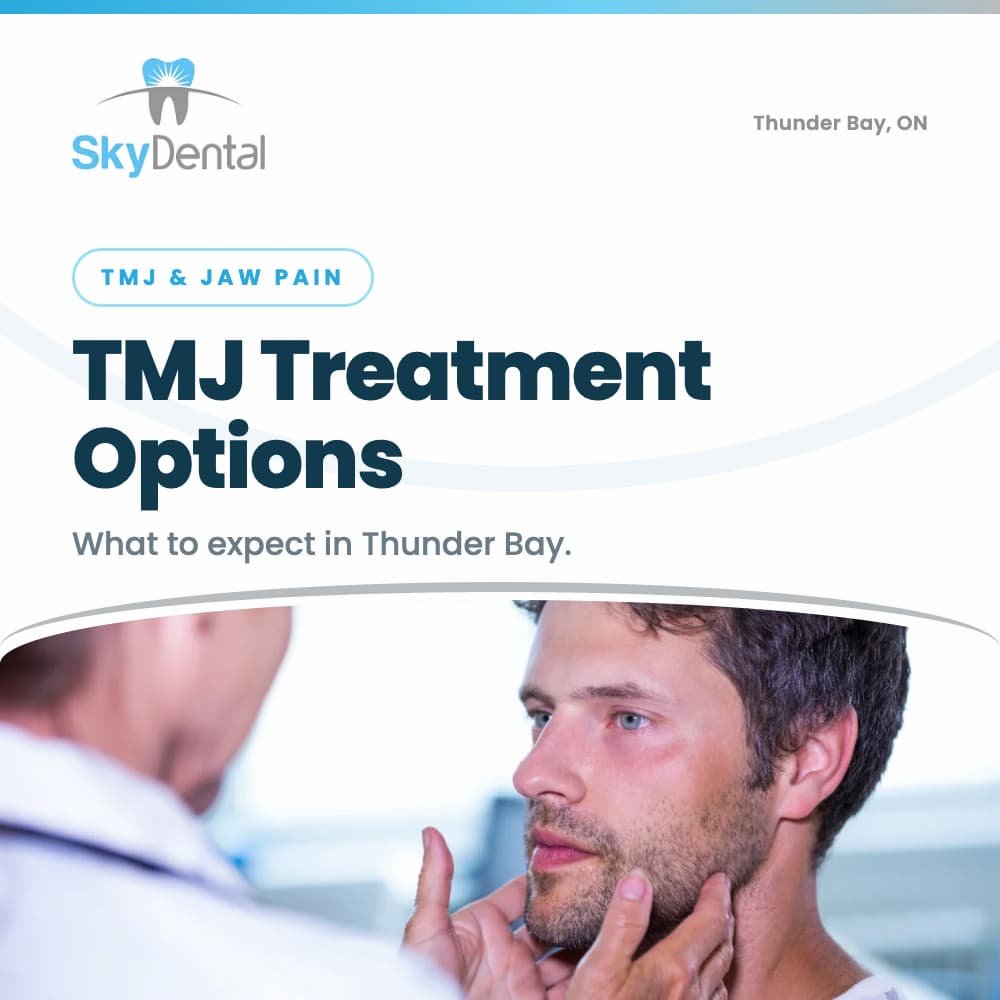
If you have been told you have TMD, or you suspect it based on jaw pain, clicking, or headaches, the natural next question is what treatment for jaw pain and TMD actually looks like. At Sky Dental Centre, Dr. Ahmed Al-Obaidi (BDS, DDS) walks patients through a realistic picture of what to expect, not a generic list of treatment types, so you have a clearer sense of what your own assessment-based plan might involve.
What Actually Happens at a TMD Treatment Appointment?
TMD treatment is not the same for every patient, and a custom occlusal splint is only one of several conservative options, not an automatic starting point. Once an initial TMJ assessment has looked at symptoms like jaw pain or clicking, your dentist recommends a plan based on what is actually found, which may include self-care guidance, monitoring over time, referral to physiotherapy or another provider, or splint therapy where it is clinically indicated for your specific presentation.
Where splint therapy is the appropriate next step, impressions or a digital scan of your teeth are taken, along with a bite registration confirming how your upper and lower teeth meet, since the splint needs to fit precisely against both your teeth and your current bite relationship. The splint is then fabricated by a dental laboratory, and a second appointment fits the splint, checking that it seats fully, does not rock or shift, and that your bite feels even across the appliance when you close. Minor adjustments are common at this visit, small high spots are identified and smoothed so the appliance distributes force evenly rather than concentrating pressure on one area.
What Does Adjusting to Splint Therapy Involve?
There is usually an adjustment period when a splint is new, some patients notice increased salivation, a feeling of bulkiness, or mild difficulty falling asleep with something new in their mouth. This is a normal part of getting used to the appliance and generally settles as you adapt to sleeping with it in place, though how quickly this happens varies from person to person.
Adaptation to wearing the splint typically comes before any noticeable change in symptoms, not alongside it. Beyond that, improvement is usually gradual rather than immediate, and the pace varies considerably between patients, some notice less morning jaw stiffness, fewer or milder headaches, or reduced muscle tenderness relatively early, others take longer, and a smaller number find splint therapy alone does not meaningfully change their symptoms. This is not universal, and no specific timeline or outcome can be promised for your individual case.
At your follow-up appointment, your dentist reassesses how your symptoms have responded and whether the splint needs any adjustment to its fit or design. This is also the point where, if symptoms have not improved meaningfully, a conversation about additional measures or specialist referral becomes more relevant. The National Institute of Dental and Craniofacial Research notes that TMD symptoms often improve gradually rather than resolving overnight.
Certain symptoms warrant prompt assessment rather than waiting for a scheduled follow-up: a jaw that suddenly locks and will not open or close, facial swelling, jaw pain following trauma or injury, fever alongside jaw pain, any new neurological symptoms such as numbness or weakness, or a severe headache that comes on suddenly. Contact the clinic or seek appropriate medical care promptly if any of these occur.
What Else Might Be Part of Your Treatment Plan?
Splint therapy is rarely the only component of a treatment plan. Self-care guidance addressing daytime clenching, jaw rest during flares, and dietary modification to avoid hard or chewy foods while symptoms are active is typically reviewed at your first visit and reinforced at follow-ups.
Worn or unstable teeth from bruxism, or missing posterior teeth changing how the bite meets, are assessed as their own separate consideration for tooth health and function, not as a standard or routine part of TMD management. Where restorative attention is genuinely needed for a tooth’s own sake, this is planned alongside splint therapy rather than instead of it, but it is not something every TMD patient requires. Stress management is also part of the conversation for many patients, since psychological stress is closely linked to clenching and muscle tension, and addressing it may help support the dental treatment.
Sleep apnea and TMD are assessed and managed as separate conditions, and having one does not mean a patient automatically needs treatment for the other. For the smaller group of patients where both genuinely coexist, sleep apnea oral appliance therapy and splint therapy for TMD are coordinated individually based on assessment, since both involve appliances that interact with jaw position overnight, but this coordination is only relevant where both diagnoses actually apply to the same patient. The American Dental Association describes occlusal splints as one of the more common conservative approaches to managing TMD symptoms.
How Do You Know If Treatment Is Actually Working?
Improvement is usually gradual, not immediate, and it is worth tracking rather than relying on memory alone. Morning jaw stiffness that used to be present every day but now shows up only occasionally is a meaningful sign. Headache frequency dropping, even if headaches have not disappeared entirely, counts as progress. Being able to open your mouth wider without discomfort, and general improvements in day-to-day jaw comfort and function, are also worth mentioning at your follow-up. Clicking on its own is common and does not reliably indicate whether treatment is working, since many people have some jaw clicking regardless of symptoms, pain, function, and overall comfort are the more meaningful things to track.
Symptoms can fluctuate with life circumstances, a stressful week or a poor night’s sleep can bring a temporary flare even when overall treatment is working. This does not necessarily mean treatment has failed, it is part of the normal variability of a condition closely tied to muscle tension and stress. What matters more is the overall trend over weeks and months, not any single day.
When Should You Go Back for a Follow-Up?
Your dentist recommends a follow-up interval based on your specific case, typically within the first couple of months of starting splint therapy, giving enough time for both adaptation and early symptom response to show themselves. If your symptoms are worsening rather than improving, or if the splint itself feels uncomfortable, causes new pain, or noticeably changes your bite when you remove it, contact the clinic sooner rather than waiting for your scheduled follow-up.
At your follow-up, expect a conversation about what has changed, a check of the splint’s fit and condition, and a decision about next steps together with your dentist, whether that means continuing as is, adjusting the appliance, adding a self-care or restorative component, or discussing specialist referral if conservative measures have not provided adequate relief.
Frequently Asked Questions
How long do I need to wear a splint for TMD each night?
Most patients are advised to wear their occlusal splint every night, consistently, rather than only on nights when symptoms feel worse. Consistency matters because a splint may help manage symptoms for some patients when clinically indicated and worn as directed, and skipping nights can reduce whatever benefit it is providing. Some patients worry about needing to wear it forever, but many find that once symptoms have stabilised, their dentist may discuss a maintenance schedule rather than nightly wear indefinitely. This is assessed individually based on how your specific case has responded, not a fixed rule that applies the same way to everyone.
Will my jaw pain go away completely with treatment?
For many patients, splint therapy and supporting measures meaningfully reduce symptoms, but a complete and permanent resolution is not something we can promise for every case. TMD is multifactorial, and how much improvement any individual sees depends on which factors are contributing, how long symptoms have been present, and how consistently self-care and appliance wear are followed. Some patients experience near complete relief, others see a substantial reduction in frequency and severity without symptoms disappearing entirely. Your dentist will give you an honest sense of realistic expectations for your specific presentation rather than a blanket promise that does not hold true for everyone.
What if the splint does not seem to be helping after a few months?
If symptoms have not improved meaningfully after a few months of consistent wear, this is worth discussing openly at your follow-up rather than continuing indefinitely without reassessment. Sometimes an adjustment to the splint’s fit resolves the issue, other times it suggests that non-dental factors, postural, stress-related, or structural joint changes, are playing a larger role than initially apparent. This is exactly the point where referral to a physiotherapist, an orofacial pain specialist, or another provider becomes a genuinely useful next step rather than continuing to rely on the splint alone. Your dentist will walk through this reasoning with you rather than simply extending treatment indefinitely. Bringing a brief log of your symptoms over those months, even a rough one, can also help your dentist see patterns that are easy to miss from memory alone.
Can I stop wearing my splint once my jaw feels better?
This is a conversation to have with your dentist rather than a decision to make on your own, since stopping too early can allow symptoms to gradually return as the underlying bruxism or muscle tension resumes without the splint’s protective effect. Some patients transition to wearing the splint less frequently once stable, while others continue nightly wear indefinitely because their underlying bruxism has not changed. Your dentist can assess your specific situation at a follow-up visit and advise on what makes sense, rather than you guessing based on how your jaw feels on a given day. Bringing this question directly to your follow-up, rather than deciding on your own between appointments, gives you an answer based on your actual progress rather than a guess.
Does TMD treatment hurt?
The treatment itself, wearing a custom occlusal splint, is not painful, though there is often an adjustment period in the first few nights involving mild discomfort, increased salivation, or a feeling of bulkiness as you get used to sleeping with the appliance. This generally settles as you adapt to the appliance, though how quickly varies from person to person. If the splint causes sharp pain, noticeably changes your bite when removed, or feels significantly uncomfortable beyond the initial adjustment period, this is not expected and warrants a call to the clinic for a fitting adjustment rather than continuing to push through it. Mentioning any unusual discomfort at your next scheduled visit, rather than waiting to see if it resolves alone, gives your dentist the chance to catch a fit issue early.
Ready to find out what treatment for jaw pain and TMD would actually look like for your specific case? Book a TMJ assessment with Sky Dental Centre in Thunder Bay.