
Introduction
Most patients who come into Sky Dental Centre in Thunder Bay for an orthodontic consultation arrive with a rough preference already in mind — but frequently that preference shifts once they understand how the two options actually work in practice. Traditional braces and Invisalign are both effective for a wide range of cases, and both are available in-house at Sky Dental. What differs is the day-to-day experience, the compliance requirements, and the clinical situations where each option tends to be better suited. This article is designed to give you a clear picture of both before your consultation.
What does orthodontic treatment actually correct?
Before comparing treatment types, it helps to understand what orthodontic treatment is designed to address. Both braces and Invisalign can treat a range of concerns: crowded or overlapping teeth, gaps between teeth, misaligned bites (including overbite, underbite, crossbite, and open bite), and teeth that are rotated or positioned at angles that affect either appearance or function.
The clinical decision about which treatment is appropriate depends on the nature and complexity of the movements required, as well as patient factors like compliance habits, lifestyle, and age. Not all cases are equally suited to both options — this is one reason the clinical consultation matters.
Traditional braces in Thunder Bay — what the experience involves
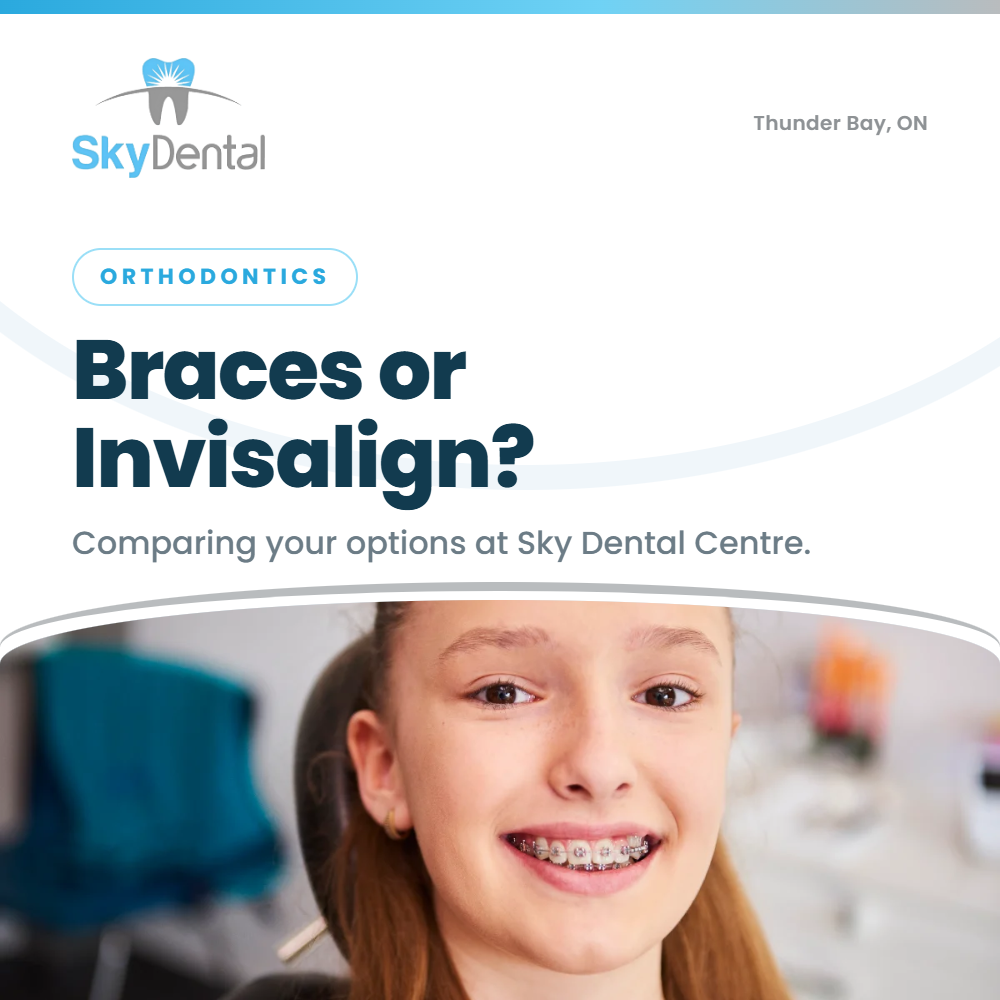
Braces consist of brackets bonded to the front surface of each tooth and connected by an archwire. The wire applies continuous, graduated pressure that shifts teeth over time. Adjustments are made at regular in-person visits — typically every four to eight weeks.
Because braces are fixed in place, they work continuously without any action required by the patient. This is a significant practical advantage for patients concerned about remembering to wear aligners. Braces are also the more established option for complex movements involving significant bite correction or substantial rotation.
The adjustment period at the start of braces treatment typically involves a few days of tenderness and adaptation. Food restrictions apply — particularly hard, sticky, or chewy foods. Metal braces are the standard choice; ceramic braces use tooth-coloured brackets and are less visually prominent.
Invisalign in Thunder Bay — how the clear aligner process works
Invisalign begins with a digital scan of your teeth at Sky Dental, which is sent to the Invisalign lab to produce your custom aligner series. Each aligner is worn for approximately one to two weeks and replaced with the next in the sequence.
The aligners are nearly invisible to casual observation and are removed for all meals, drinks other than water, and oral hygiene. Invisalign requires consistent wear — twenty to twenty-two hours per day. Patients who regularly wear aligners for shorter periods will find that treatment timelines extend.
Check-in appointments for Invisalign are typically every six to eight weeks — fewer in-office visits than braces, which is a practical consideration for those with demanding schedules or who are traveling from outside Thunder Bay.
How to think through the choice between braces and Invisalign
Visibility: Braces are visible during treatment. If visibility is a significant concern, Invisalign or ceramic braces are worth exploring.
Compliance: How realistic is consistent aligner wear for your daily life? If you frequently skip meals or anticipate situations where managing a removable appliance would be difficult, braces may be more reliable.
Diet: Braces require avoiding hard and sticky foods. If dietary restrictions are a meaningful concern, Invisalign removes that constraint.
Case complexity: For some clinical situations, braces offer more predictable outcomes. The clinical team will identify whether your case is one where this applies.
These are starting questions rather than definitive answers. The right treatment is the one that is clinically appropriate and realistically sustainable given your life.
Is there a better time of year to start orthodontic treatment in Thunder Bay?
For teenagers and students, there is a practical case for starting orthodontic treatment in summer. The initial adjustment period — the first two to four weeks of any orthodontic treatment — is easier to manage during a period with fewer structured commitments. Starting in June or July means this phase is largely behind you before September.
For working adults, the timing question is more individual. The adjustment period is real but not incapacitating — most adults manage it while continuing to work normally. Sky Dental sees orthodontic patients throughout the year. The practical advantage of a summer start is simply about managing the adjustment period at a time of your choosing.
Frequently Asked Questions
Can I choose between braces and Invisalign at Sky Dental in Thunder Bay?
In most cases, yes — but the clinical team will confirm which options are appropriate for your specific situation at consultation. Some cases are better suited to one treatment over the other based on the movements required. The team will explain the reasoning for any recommendation.
Is Invisalign as effective as braces for teeth straightening?
Invisalign is clinically effective for a wide range of orthodontic cases. For certain complex movements, traditional braces may offer more predictable outcomes. Whether Invisalign is appropriate for your case is determined through clinical assessment at Sky Dental.
How often do I need to come in for appointments with braces vs Invisalign?
Braces typically require in-person adjustment visits every four to eight weeks. Invisalign check-ins are scheduled every six to eight weeks for most patients, since aligner changes happen at home.
Can adults get Invisalign at Sky Dental Thunder Bay?
Yes. Invisalign is available for adult patients at Sky Dental. Many adults in Thunder Bay choose Invisalign for its discretion and removability. Adult candidacy is confirmed through clinical assessment.
What happens to my teeth after orthodontic treatment ends?
Following active orthodontic treatment, a retainer is typically prescribed to maintain the position of your teeth. Teeth have a natural tendency to shift over time without retention. The clinical team will explain the recommended retention protocol for your case.
Sky Dental Centre offers both traditional braces and Invisalign in Thunder Bay.
To find out which option fits your situation, book a consultation at or call. Flexible scheduling is available for working adults, students and new patients.