
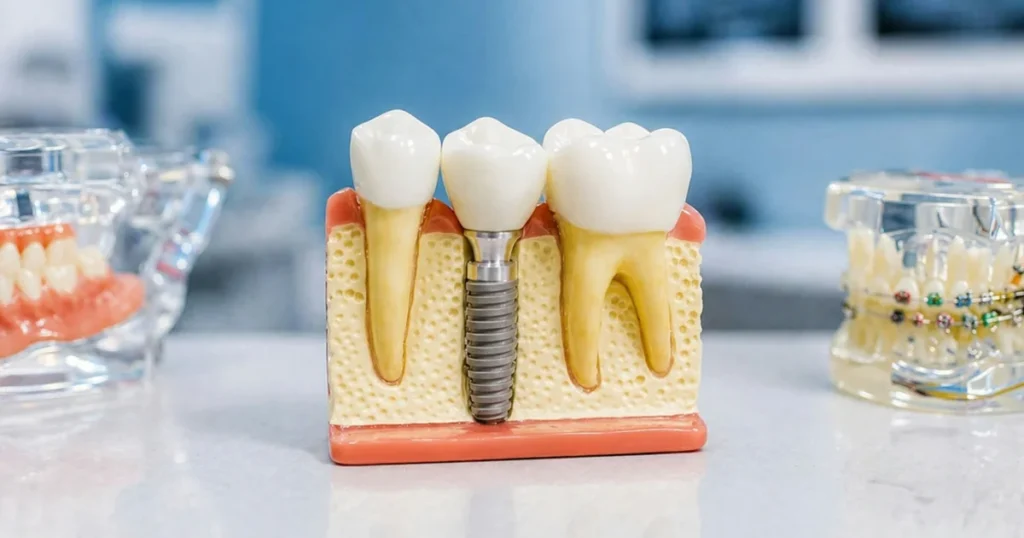
Dental implants are artificial tooth roots, usually made of titanium or another biocompatible material, that are surgically placed in the jawbone to support replacement teeth. Once healed, an implant can hold a single crown, an implant-supported bridge or certain types of dentures.
Unlike a traditional bridge, a single tooth implant does not rely on the neighbouring teeth for support. Unlike a removable denture, it is anchored in the bone. Implants can help restore chewing, improve the look of your smile and help maintain the bone around the implant.
Dental implant candidacy depends on your oral health, how much bone you have and careful treatment planning. Not everyone can have implants right away, and some people need preparatory treatment first. This guide from Sky Dental Centre in Thunder Bay explains how implants work, who they suit, how the dental implant procedure works and how to care for them, so you can have an informed conversation at your consultation.
What Are Dental Implants and How Do They Work?
A dental implant is a small post placed in the jawbone that acts like a tooth root and supports a replacement tooth or teeth. The U.S. Food and Drug Administration describes implants as devices surgically placed in the jaw to restore chewing ability or appearance.
The main parts of an implant
| Implant Component | Primary Function |
| Implant fixture | Provides support within the jawbone |
| Abutment | Connects the implant to the restoration when required |
| Crown, bridge or denture | Replaces the visible or functional part of missing teeth |
Implant systems and restoration designs vary, so not every case uses the same parts.
How osseointegration works
After placement, the bone gradually grows against and bonds with the implant surface. This process, called osseointegration, gives the implant the stability it needs to support a replacement tooth. The Canadian Dental Association explains that healing takes several months as the implant bonds with the bone.
Single tooth implants
A single tooth implant replaces one missing tooth with one implant and one crown. The teeth on either side do not usually need to be reshaped, as they would for a conventional bridge.
Implant-supported bridges
When several teeth in a row are missing, a bridge can be attached to two or more implants, so fewer implants support more teeth.
Implant-supported dentures
Implants can also help hold a removable denture in place or support a fixed full-arch restoration.
Implants vs. natural teeth
Implants are not the same as natural teeth. They do not have the living ligament that cushions a natural tooth, and they can still develop gum and bone problems. They need daily cleaning and regular professional care.
Who Is a Good Candidate for Dental Implant Treatment?
A good candidate for dental implants is an adult with one or more missing teeth, enough healthy jawbone, healthy or well-managed gums and general health that allows safe surgery and healing. Your dentist decides through a full examination.
Adults with missing teeth
Implants can replace one tooth, several teeth or a full arch. The number and position of missing teeth shape the plan.
Enough jawbone
Implants need enough bone volume and quality to be stable. Bone can shrink after tooth loss or gum disease.
Healthy gums
Active gum disease needs to be treated before implants are placed, because it can affect the tissues around the implant.
General health
Your overall health affects surgery and healing. Some conditions and medications need extra review.
Controlled chronic conditions
Conditions such as diabetes do not automatically rule you out. How well the condition is controlled matters. The FDA notes that uncontrolled diabetes and smoking can raise the risk of complications.
Smoking
Smoking can slow healing and increase the risk of implant failure. Your dentist may advise stopping before and after treatment.
Not enough bone
A bone graft can sometimes add volume before or during implant placement. Grafting is not always needed or possible.
Grinding and heavy bite forces
Clenching or grinding can affect implant design, restoration choice and long-term care.
Age
Implants are usually placed once jaw growth is complete. There is no set upper age limit.
When implants may not be recommended
Extra assessment, or a different option, may be needed with:
- Uncontrolled gum disease.
- Too little bone.
- Some uncontrolled medical conditions.
- Some medications or past treatments that affect bone healing.
- Poor oral hygiene.
- Inability to undergo the required procedures.
| Assessment Factor | Why It Matters |
| Jawbone volume and quality | Influences implant placement and stability |
| Gum health | Affects surrounding tissue health and maintenance |
| Medical history | Helps identify surgical and healing risks |
| Smoking status | May influence healing and long-term outcomes |
| Oral hygiene | Helps prevent implant-related complications |
| Bite and tooth position | Affects implant placement and restoration planning |
| Patient expectations | Helps match treatment goals with realistic outcomes |
What Are the Benefits of Dental Implants Compared With Other Tooth Replacement Options?
Dental implants can replace teeth without relying on neighbouring teeth, offer strong stability and help maintain bone around the implant. Bridges and dentures also have clear advantages, so the best option comes down to your situation.
Potential benefits
- Neighbouring teeth are left alone: a single implant does not usually require reshaping healthy teeth.
- Chewing: implant-supported teeth can feel stable when you eat.
- Bone around the implant: implants place force on the jawbone in a way that can help maintain bone around them, although they do not prevent all bone loss.
- Appearance: crowns can be made to blend with your natural teeth. Gum shape, bone and tooth position all affect the result.
- Stability compared with dentures: implant-retained dentures can move less than conventional ones. Traditional dentures still suit many people.
- Long-term replacement: with good care, implants can last many years, though nothing is guaranteed for life.
Limitations
- Surgery is required.
- Healing takes months.
- Upfront costs can be higher.
- Bone grafting may be needed.
- Infection or implant failure can occur.
- Ongoing professional maintenance is needed.
- Crowns and other parts may need repair or replacement.
| Comparison | Dental Implants | Dental Bridges | Removable Dentures |
| Tooth replacement method | Implant-supported restoration | Prosthesis supported by neighbouring teeth or implants | Removable appliance |
| Surgery required | Usually yes | Usually no | Usually no |
| Neighbouring tooth preparation | Not usually needed for a single implant | Often needed for traditional bridges | Not needed in the same way |
| Removability | Depends on the design | Usually fixed | Removable |
| Bone support | Can help maintain bone around the implant | Does not replace the tooth root | Does not replace the tooth root |
| Maintenance | Daily cleaning and implant checks | Daily cleaning and dental examinations | Daily cleaning, adjustment and periodic replacement |
| Treatment time | Several stages and healing periods | Often fewer stages | Varies by denture type |
| Suitability | Depends on bone, gum and overall health | Depends on supporting teeth and oral health | Depends on anatomy, oral health and preferences |
Are dental implants better than bridges or dentures?
No single option is best for everyone. Your dentist will consider:
- How many teeth are missing and where.
- The condition of your jawbone.
- The health of neighbouring teeth.
- Gum health.
- Medical history.
- Cost.
- Your preferences.
- Long-term maintenance.
Learn more about our Dental Crowns & Bridges service if you are comparing fixed options.
What Happens During the Dental Implant Procedure?
The dental implant procedure usually involves a consultation, planning, any preparatory treatment, implant placement, a healing period, and then fitting the final crown, bridge or denture.
| Treatment Stage | What Happens | Important Considerations |
| Consultation | Examination and discussion of replacement options | Determines preliminary suitability |
| Diagnostic planning | Imaging and review of bone and oral health | Guides implant positioning |
| Preparatory treatment | Extraction, gum treatment or grafting when needed | May extend treatment time |
| Implant placement | Implant inserted into the jawbone | Surgical procedure that needs healing |
| Osseointegration | Bone bonds with the implant | Healing varies by patient |
| Final restoration | Crown, bridge or denture fitted | Restores function and appearance |
| Maintenance | Ongoing examinations and cleaning | Supports long-term implant health |
- Consultation: Your dentist reviews your health, oral condition, missing teeth and goals. X-rays and 3D imaging, such as a CBCT scan, may be used when appropriate.
- Planning: Bone, gums, bite and the planned restoration are reviewed to decide implant position and design.
- Preparatory treatment: Some people need Tooth Extractions, gum treatment, a bone graft or treatment of an infection first. Not everyone does.
- Implant placement: The implant is placed in the jawbone, usually under local anesthetic.
- Healing: The bone bonds with the implant over several months.
- Abutment: This connector may be added after healing or at an earlier stage, based on the system.
- Final restoration: A custom crown, bridge or denture is attached.
- Follow-up: Regular visits check the implant, gums, restoration and your cleaning routine.
Our article on the dental implant procedure walks through each stage.
Is dental implant surgery painful?
Local anesthetic numbs the area during placement, so you should feel pressure rather than pain. Swelling, bruising or tenderness afterward is common and usually settles. The procedure and your healing affect how much discomfort you feel.
How long does the dental implant procedure take?
The placement appointment itself can be fairly short in straightforward cases. The whole process usually takes several months, because of healing time, and longer if extractions or grafting are needed. Ask your dentist for an estimate for your case.
How Long Do Dental Implants Last and How Should You Care for Them?
Dental implants can last many years with good care. Your bone, gums, hygiene, habits and regular maintenance all affect how long. The implant and the crown on top have separate lifespans, and crowns may need replacing over time.
Factors that affect how long implants last
- Quality and quantity of supporting bone.
- Health of the gum and tissue around the implant.
- Oral hygiene.
- Smoking.
- Medical conditions that affect healing.
- Bite forces and grinding.
- Implant position and restoration design.
- Regular professional maintenance.
Daily care
Brush twice a day around the implant crown and clean between teeth or under bridges with floss, interdental brushes or other tools your dentist recommends.
Regular dental visits
Your dentist checks implant stability, gum health, bone levels and the restoration. Implants may need cleaning methods suited to their surfaces.
Avoid tobacco and protect against grinding
Smoking raises the risk of problems. If you grind your teeth, a protective night guard may be recommended.
Signs of implant problems
See your dentist if you notice:
- Gums that bleed around an implant.
- Swelling or tenderness.
- Increasing discomfort.
- A loose crown or part.
- A change in your bite.
- Unusual discharge.
- Movement of the implant.
Peri-implant disease
The American Academy of Periodontology explains that peri-implant mucositis is inflammation of the gum around an implant without bone loss, which can be reversed if caught early. Peri-implantitis involves inflammation plus loss of the supporting bone and usually needs more involved treatment. Past gum disease, poor plaque control, smoking and diabetes raise the risk.
What Are the Risks of Dental Implants?
Dental implant treatment is generally predictable, but it carries risks like any surgery. The FDA lists possible complications such as damage to nearby teeth, sinus problems, nerve injury causing numbness, screw loosening and implant failure.
- Temporary symptoms: swelling, bruising, tenderness and minor bleeding.
- Infection: after surgery or around the implant later.
- Implant failure: the implant may not bond with bone or may lose support over time.
- Nerve or sinus problems: depending on where the implant is placed.
- Graft complications: grafts add healing time and their own risks.
- Mechanical problems: crowns, screws or other parts can loosen or break.
- Peri-implantitis: can threaten long-term stability.
Careful diagnosis, planning, a full medical history, good hygiene and follow-up care help lower these risks.
How Much Do Dental Implants Cost?
Dental implant costs vary with the number of implants, any extractions or grafting, imaging, the type of crown, bridge or denture, and how complex the surgery is. A single tooth implant often involves separate fees for the implant, the abutment and the crown.
Insurance coverage varies, so check with your insurer. Ask for an itemized written estimate that lists every stage.
Choosing a Dentist for Dental Implant Treatment
Choose a provider who plans carefully, explains your options honestly and coordinates your care from surgery to the final crown.
Look for:
- Appropriate qualifications and registration with the Royal College of Dental Surgeons of Ontario.
- Training and experience in implant treatment.
- A full examination and appropriate imaging.
- A clear discussion of your candidacy, benefits, risks and alternatives.
- A transparent, itemized estimate.
- Coordination between surgical and restorative care.
- Follow-up and long-term maintenance.
- Referral for complex cases when needed.
Implant care may involve general dentists, periodontists, oral and maxillofacial surgeons or prosthodontists. Ask who will place the implant, who will make the final restoration and how follow-up will work.
Dental Implants in Thunder Bay: Exploring Your Tooth Replacement Options
A consultation is the first step if you are thinking about dental implants. Your dentist will check your missing teeth, jawbone and gums and explain each stage, from surgery and healing to the final restoration and ongoing care.
If you are looking for a Dentist in Thunder Bay, Sky Dental Centre offers Dental Implants in Thunder Bay. Dr. Ahmed Al-Obaidi (BDS, DDS) provides implant assessment and treatment as part of his general dental practice, so the process is managed in one clinic. We offer single implants, implant-supported bridges and implant-supported overdentures, and in many cases we use a CBCT scan to see the bone in three dimensions before planning placement. Implants are placed under local anesthesia, and you receive a full written cost breakdown at your consultation.
Call us to confirm consultation availability, treatment stages and costs.
Frequently Asked Questions
What are dental implants and how do they work?
Dental implants are artificial tooth roots, usually titanium, placed in the jawbone to support replacement teeth. Over a few months, the bone bonds with the implant so it can hold a crown, bridge or denture. Your oral health and clinical situation decide whether it will succeed.
Who is eligible for dental implants?
Adults with missing teeth, enough jawbone, healthy or well-managed gums and suitable general health may be eligible. Some people need bone grafting or gum treatment first. A dental assessment decides whether implants suit you.
How long does the dental implant procedure take?
The placement appointment may take about an hour or more, depending on how many implants are placed and how complex the case is. The full process often takes several months because the bone needs time to heal and bond with the implant. Extra procedures can add time.
Are dental implants better than dentures or dental bridges?
Not always. Implants offer stability and can replace one tooth without reshaping neighbouring teeth. However, bridges or dentures may suit some people better because of bone, gum health, preferences or cost. The best option reflects your situation.
How long do dental implants last?
Dental implants can last many years with good care. Hygiene, gum health, smoking, bite forces, medical conditions and regular check-ups all affect lifespan. Crowns and other parts may need repair or replacement over time, and implant survival is not guaranteed.
Making the Right Choice for Missing Teeth
Dental implants can be a reliable long-term way to replace missing teeth when your bone, gums and health allow it. Comparing implants with bridges and dentures, and understanding each stage of treatment, helps you choose the option that fits your needs.
Missing one or more teeth? Book a consultation to find out whether you are a candidate, and to talk through treatment stages, healing, costs, risks and maintenance. Book an appointment online.
This article is general information, not dental advice for your situation. Speak with a dentist about the right option for your teeth.